In brief
Before the show
- Go to a ringcraft class to practise
- Start with an Open show rather than a Championship show
- Enter online or by post before the closing date
- Pack a show lead and a ring clip
On the day
- Arrive early and walk your dog round the ring while it's empty
- Find your number on your exit pass, or buy or borrow a catalogue
- Watch the classes before yours to see how the judge works
Find a ringcraft class first
Ringcraft classes are training evenings where you practise showing your dog: standing them for the judge, moving them round the ring, and getting them used to being handled by strangers. They're usually weekly, often in a village hall, and they're the best place to learn before you enter anything.
Look for a friendly, supportive group. As well as the practice, it gives you people to ask the odd questions that come up, and a gang to hang around with at shows. Going to a show where you don't know anyone can be daunting. Your breed club, people at local shows and Facebook showing groups can all point you to one near you.
The first ringcraft group I went to was Roding Ringcraft in Essex. They were wonderfully patient and supportive while we were starting out. When we moved to Norfolk we found Shelfanger Ringcraft, who are just as supportive and always on hand for my more obscure showing questions.
Start with an Open show
Open shows are smaller and more relaxed than Championship shows, and there are no Challenge Certificates (CCs) at stake, so the pressure is lower. That makes them a good practice ground for you and your dog. Once you're both comfortable, Championship shows are the next step.
Your dog needs to be at least 6 months old on the day, and registered with the Royal Kennel Club in your name. Our show classes guide explains which classes they can enter.
Entering
- Shows publish a schedule listing the judges, the classes for each breed and the closing date for entries.
- Most shows take entries online through Fossedata or Higham Press, where you can also find schedules. Some still take postal entries on the form in the schedule.
- Entries close weeks before the show, often earlier for postal entries than online ones. Late entries aren't usually accepted.
- You'll need your dog's registered name and number, their date of birth, and their sire and dam.
Which ring, and what time?
The ring plan tells you which ring your breed is in, and the running order within it. It's sometimes printed in the schedule. If not, it's usually posted on the entry website or the show society's Facebook page closer to the day, often along with the number of entries for each breed.
On the day, Open shows usually put printed ring plans up at the entrances, and the show secretary can point you to your ring. At big Championship shows there are often stewards and organisers dotted around the rings who can send you the right way.
As for what time you'll be in the ring, it's the question everyone asks, and the honest answer is: how long is a piece of string? The schedule usually gives the time judging starts on its front cover.
Look out for “N.B.” in the ring plan. It stands for “not before”, so “N.B. 10:30am” means that breed won't start before 10:30am.
Otherwise, it's not an exact science. With time, you'll get a feel for how long it takes from how many breeds and dogs are ahead of you, but some judges are incredibly quick and others take their time and enjoy their day. Absentees can speed things up too, so be ready earlier than you think you need to be.
Ring numbers and the catalogue
Every exhibitor in the ring wears a number. At Open shows the steward usually hands it to you as you go into the ring for your class. To find out which number is yours, look yourself up in the show catalogue, which you can buy at the show.
At Championship shows you usually download and print your exit passes before the show, and at many, especially unbenched ones, your ring numbers too. Exit passes are checked as you leave and are linked to your dog. Each one has your dog's Kennel Club name and usually their number, which also helps you find your bench. At benched shows your ring number is often waiting on the bench. If you forget to print anything, the show office can usually help, and we've even seen exhibitors write their number on card in marker pen.
You attach your number to a ring clip, a small clip that holds the card on your chest or waist. People will remind you to bring your show lead. Fewer will mention the ring clip.
Our first show was the Guildford and District Canine Society Open show in 2022, with our Norwich Terrier, Cheddar. Beforehand, my husband and I had been to ringcraft a couple of times and talked to people in our breed. Everyone asked the same thing: “Have you got a show lead?” We said yes, and not to worry.
When we arrived, we noticed every exhibitor in the ring was wearing a number. We asked where to get one and were told the steward hands them out in the ring, you find your number in the catalogue, and then you just pop it in your ring clip. That's when we realised we'd never heard of a ring clip, let alone brought one. None of the stands had any for sale, so I made one out of two safety pins I happened to have in my bag.
Ever since, I make a point of mentioning ring clips to new exhibitors, and I've lent out a few too.
Our dog show kit list covers everything else worth packing.
Benched and unbenched shows
The schedule tells you whether a show is benched. At a benched show, each dog has their own numbered bench: a raised, partitioned bay where the dog can wait between classes. Your bench number matches your ring number. Championship shows are more likely to be benched than Open shows.
How much benches get used depends on the breed. Some breeds use them religiously. In others, exhibitors gather in the grooming areas instead and only really use the benches at Crufts. Ask people in your breed what they do. If your dog does stay on their bench, secure them with a benching chain, or put a crate on the bench, and bring something comfy for them to lie on. With a small breed, the bench also makes handy storage for your bags and grooming kit while your dog waits in their trolley or on the grooming table.
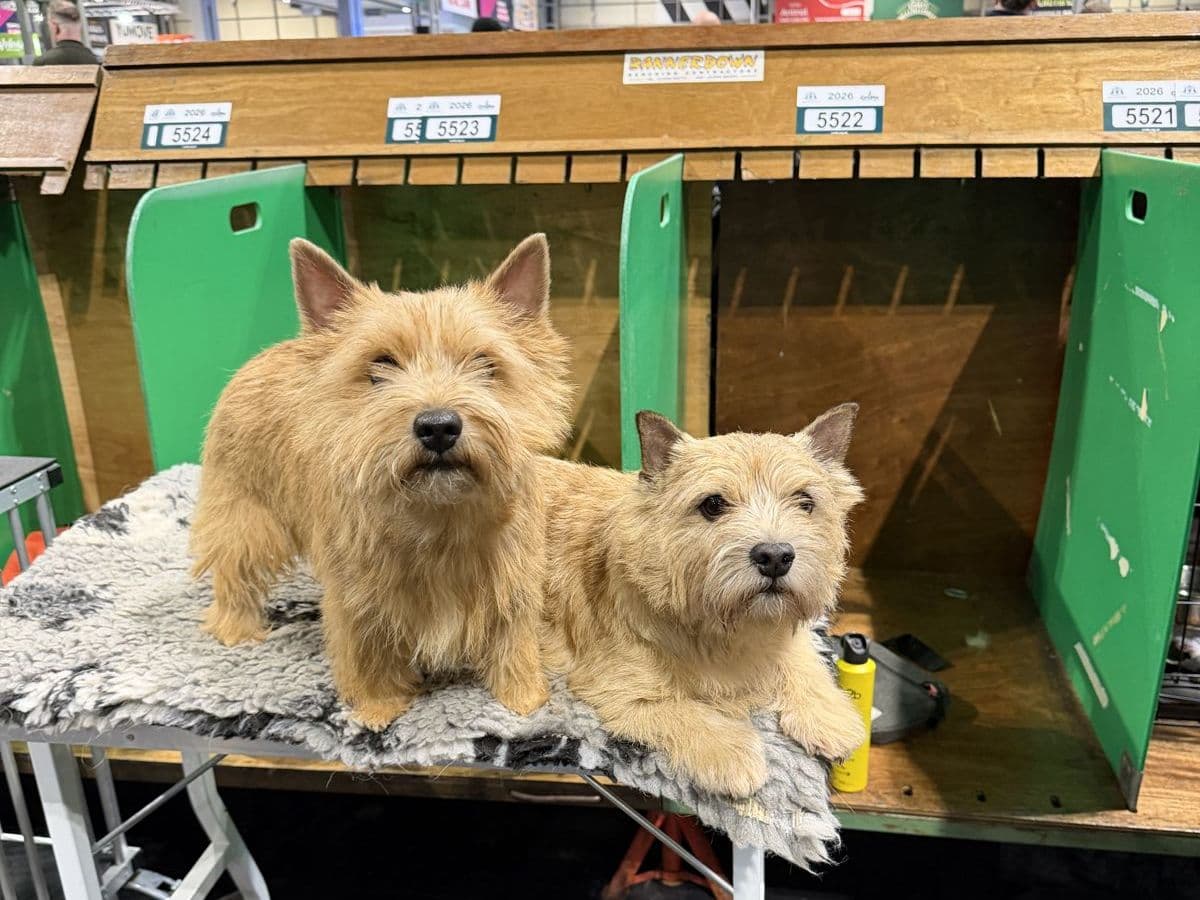
At an unbenched show, there are no set places, so you find your own spot near your ring, often with a crate and a chair. Most Open shows are unbenched.
Don't set up right next to the ring, as you may be asked to move back, and keep clear of doorways and walkways for the same reason. Space can be tight, so squeeze into any spot you can find. You might get the odd huff from someone whose space you're joining, but most exhibitors are happy to shuffle up and make room. In return, be considerate: keep your setup compact, don't spread out more than you need, and shuffle up for the next person too.
What to wear
There's no written dress code, but exhibitors dress smartly. Open shows are a bit more relaxed, so think smart-casual. Championship shows are properly smart.
Whatever you wear, you'll need to move in it, as you'll be running round the ring with your dog. Comfortable shoes with a good grip are a must, and pockets are handy for bait. Many exhibitors also pick a colour that contrasts with their dog, so your dog stands out against them rather than blending in.
In the ring
Arrive early. If you get there before judging starts, walk your dog around the ring. It gets you both used to the ring and to its smells and sounds, and it's a good way to settle your dog and get them in the zone before your class. Many experienced exhibitors still do this at every show.
- The steward calls each class into the ring. Be ready nearby, as the judge won't usually wait for latecomers.
- The judge looks at all the dogs together, and will often ask you all to move round the ring as a group.
- The judge will then examine each dog in turn. Smaller breeds are usually stood on a table. While the judge is watching the dog before yours move, get your dog set up and standing nicely, so they're ready when the judge turns round. It makes a good first impression, keeps the class moving, and saves you an awkward moment getting your dog into place.
- The judge asks you to move your dog, often in a triangle or straight up and back, so they can see how your dog moves.
- Remember the golden rule: the judge is there to look at your dog, not you, so never get between the judge and your dog. Dogs are usually shown on your left-hand side.
- After seeing every dog, the judge picks their placings. At most shows that's 1st, 2nd and 3rd, then Reserve and Very Highly Commended (VHC).
- Dogs that win their class and haven't been beaten in another class come back in for the challenge, where they compete for Best Dog or Best Bitch. The two winners then meet for Best of Breed.
Watching the classes before yours shows you how the judge likes dogs moved and stood, so you're not caught out when it's your turn.
New to the jargon? Our dog show glossary explains the terms you'll hear around the ring.
Get to know your breed
People at shows tend to stick with their own breed, a bit like gangs (but friendlier). That's useful. As you get to know the people around your ring, you'll know who's in the class before yours, so you can be ready in time. They're also the best people to ask about showing your breed, because every breed has its own quirks.
One to find out early is whether your breed is free stacked. Norwich Terriers are meant to stand themselves, rather than having their legs placed by hand, and plenty of other breeds aren't shown like that. I taught mine to spin on command, which helps reset them into a nice stand when they've shuffled out of position.
Critiques
A critique is the judge's written report on the dogs they placed. At Championship and Open shows, judges have to write one for the 1st and 2nd placed dogs in each breed class, so don't expect one for a 3rd or below. If you're lucky enough to be placed in the Group or in Best in Show, those judges usually write about their winners too. If the same judge did all of them, it may all be in one critique.
Critiques don't appear straight after the show, so there's no point asking for yours that evening. Judges post them on the Royal Kennel Club's judges' critiques website, and many also share them in dedicated Facebook groups. Judges are allowed three months to publish their critique. If yours still hasn't appeared after that, you can report it to the Royal Kennel Club, as long as you do so within six months of the show.
After the show
Write down your results while you remember them, including the judge and what you thought of their placings. Ring & Rosette keeps your results in one place, lets you add the judge's critique when it appears, and works out your Junior Warrant points, which classes your dog can still enter, and whether they have qualified for Crufts.
Questions
- How do I know which ring I'm in?
- Check the ring plan. It's sometimes in the schedule, or posted on the entry website or the show society's Facebook page. At the show, Open shows usually put ring plans up at the entrances, and the show secretary or stewards can point you the right way.
- What time will my breed be judged?
- Check the schedule for when judging starts and the ring plan for the running order. Show societies often post the ring plan and entry numbers on the entry website or their Facebook page. N.B. in a ring plan means "not before", so a breed marked N.B. 10:30am won't start before then.
- When will I get my critique?
- Judges must write critiques for 1st and 2nd in each breed class at Championship and Open shows. They have three months to publish them on the Royal Kennel Club's judges' critiques website. A missing critique can be reported to the Royal Kennel Club up to six months after the show.
- Should my first show be an Open show or a Championship show?
- An Open show. They're smaller and more relaxed, with no Challenge Certificates at stake, which makes them good practice for you and your dog.
- Where do I get my ring number?
- At most Open shows the steward hands it to you as you go into the ring. At Championship shows you often print your ring numbers at home before the show, or find them on your bench at benched shows. Your number is in the show catalogue and usually on your exit pass.
- What is a ring clip?
- A small clip that holds your ring number on your chest or waist while you show your dog. It's easy to forget, so pack one with your show lead.
- How old does my dog have to be to enter a show?
- At least 6 months old on the day of the show, and registered with the Royal Kennel Club in your name.
- What is ringcraft?
- Training classes where you practise showing your dog: standing them, moving them and having them handled by a judge. They're the best way to prepare for your first show.